
INDEX OF QUALITATIVE VARIATION: (for Nominal and discrete Ordinal Data)
IQV measures the ratio of the actual variation divided by the highest possible variation
IQV=
where: k = # of categories
N = # of cases
f2 = sum of the squared frequencies
Example:
| ABORTIONS | ||
| Always wrong | 6 | 36 |
| Wrong except self defense | 1 | 1 |
| Wrong except S.D. & rape | 9 | 81 |
| Personal choice of both parents | 31 | 961 |
| Woman's choice | 25 | 625 |
| N = | 75 | 1,704 |
Q: What is spread or variation
in abortion attitudes?
A: IQV = 
SOURCE: STUDENT SURVEY SDSU 1995
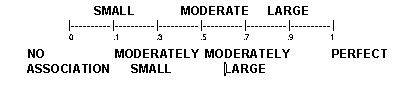
Interpretation:
B. Interval Data and continuous Ordinal Data: Range
Range is found by subtracting the lower true limit of the lowest category from the upper true limit of the highest category.
Example: Ages of Sociology 201 Students
| Ages (NB) | lower true limit | upper true limit | f | cum f |
| 18-22 | 17.50 | 22.499 | 54 | 54 |
| 23-27 | 22.50 | 27.499 | 13 | 67 |
| 28-32 | 27.50 | 32.499 | 3 | 70 |
| 33-37 | 32.50 | 37.499 | 3 | 73 |
| 38-42 | 37.50 | 42.499 | 1 | 74 |
| 74 = N |
SOURCE: STUDENT SURVEY SDSU 1995
Example: 42.499 - 17.50
= 25 The range of this sample is 25 years.
C. Inter Quartile Range: measure the range of the middle 50% .
IQR = P75 - P25 where:
(note the 75 to 25 could be any range but this specifies
the middle 50%)
P75 =  P25
=
P25
= 
cfbelow = cumulative frequency below interval containing the percentile.
f = the number of cases in the interval containing the percentile.
i = width of interval
N = total number in sample
LTL = lower true limit of the interval containing
the percentile.
P75 =  P25
=
P25
= 
23.077 - 17.519 = 5.56 years